Creating accessible pathways for blue-collar workers to transition into white-collar roles.
Saksham (meaning capable) is a mobile platform that creates accessible pathways for India's blue-collar workers to transition into entry-level white-collar roles: daily learning in regional languages, certification, and weekend work opportunities, all built to fit around existing jobs.
A self-initiated 2-week sprint where I owned the strategy, UX, UI, and design system end to end: from secondary research and in-depth interviews with 5 blue-collar workers, through personas, ideation, and wireframes, to a branded app prototype.
- Project
- Self-initiated Project
- Role
- UX & UI, Strategy, Design System
- Timeline
- 2-Week Sprint (2022)
- Tools
- Figma, Adobe Illustrator, Adobe After Effects
30%
potential income increase for successful users, with up to 80% job placement for those completing all program components
~20%
of informal workers projected to transition into formal employment within 5 years, improving economic mobility and reducing inequality
In a country where dreams are plentiful but ladders are few, millions of workers face an invisible ceiling.
In India, over 90% of 450 million workers remain in informal or blue-collar jobs, blocked by skill gaps and limited access to opportunity. Government programs exist, but few connect skill-building to real employment.

Many working young men & women fear losing their existing jobs and being unable to fulfill their basic necessities.
Only ~10% of India's workforce was in the formal sector as of 2018, and 70% of employers report difficulty finding workers with the right skills.
Blue-collar workers also face systematic barriers to career advancement despite aspirations for better economic prospects. These barriers include:

Lack of information around relevant skills in the market.

Existing work commitments that prevent traditional education paths.
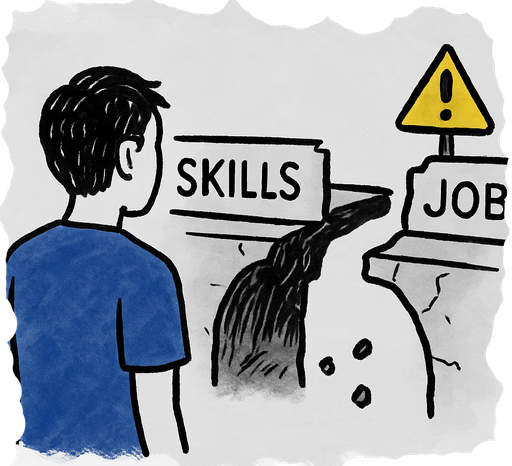
Lack of access to affordable skill development programs and job placement support.
“I've been working as a factory worker for 8 years. I wish to do more, but where to start? Training programs are too expensive, and I can't afford to quit my job to study.”
— Factory Worker, Pune
“I completed basic computer courses at a local center, but no company will hire me without experience. I need skills for jobs, but can't get jobs without experience.”
— Construction worker, Mumbai
Four connected surfaces, all built to fit around a job someone already has.
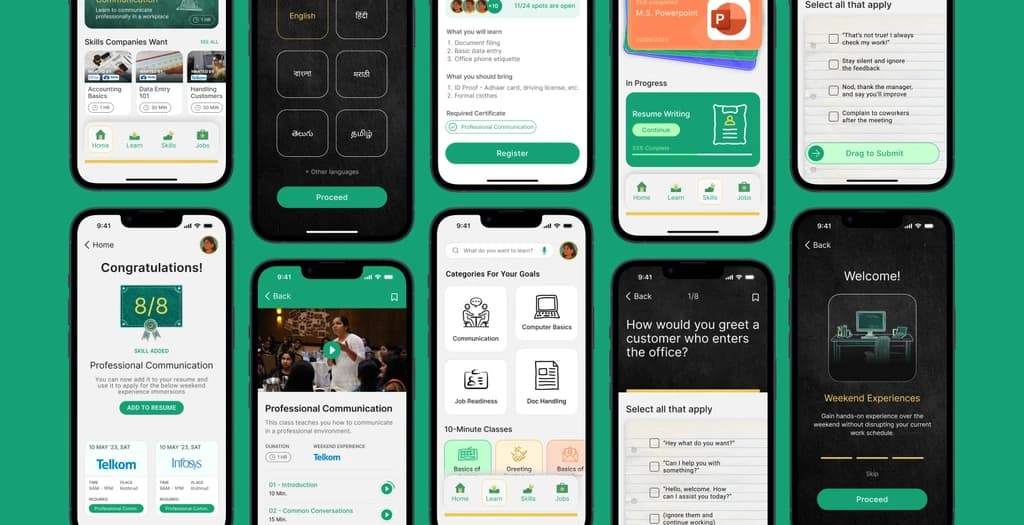
Daily learning in regional languages, certification, and weekend work opportunities: with guided steps and hands-on experience, Saksham enables low-risk career growth for workers often left out of traditional upskilling.
A simple dashboard that suggests what to learn today, based on your goals. Designed for people with limited time.
Each course ends with a skill test that gives users a certificate and unlocks related weekend work opportunities.
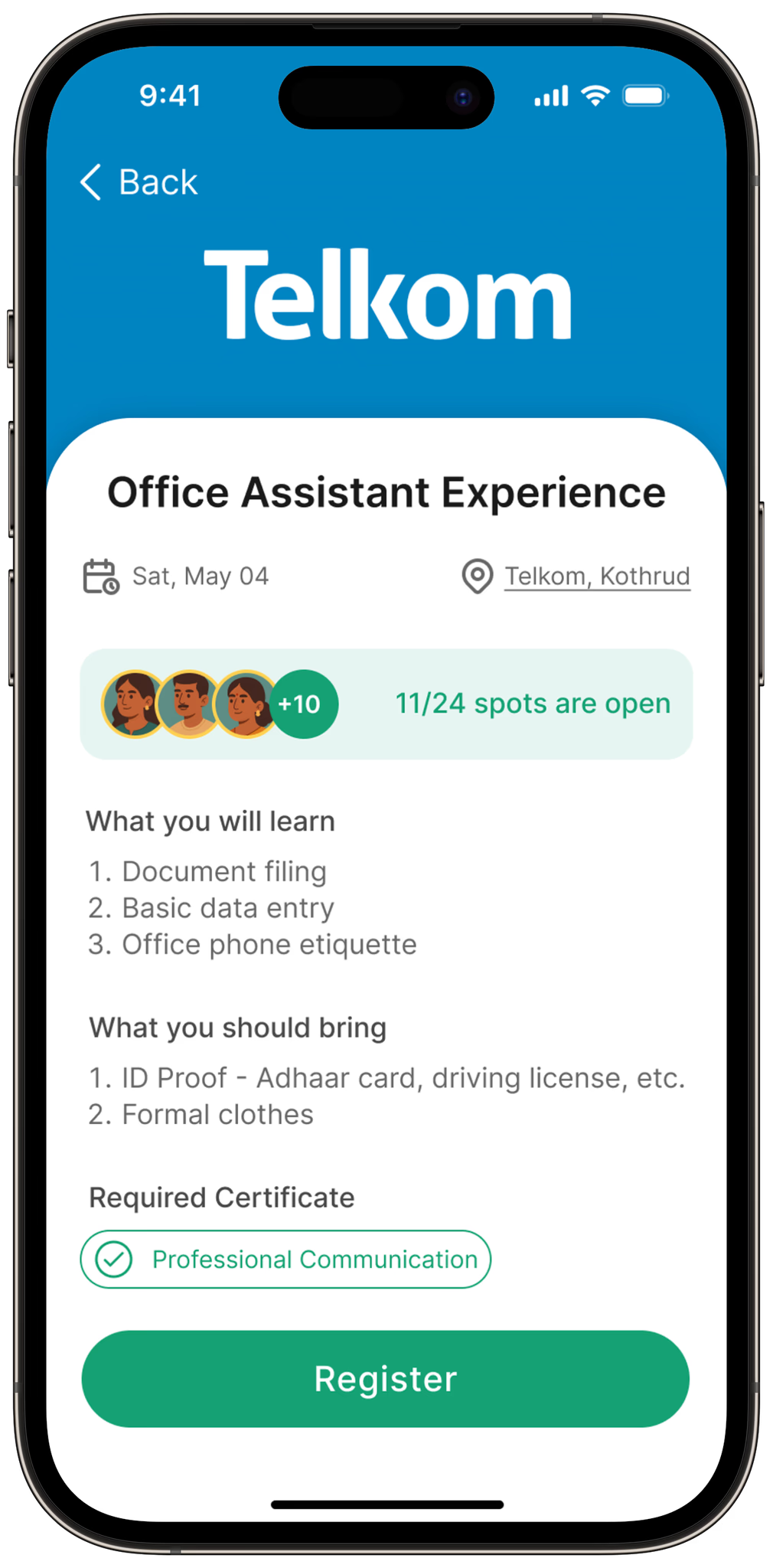
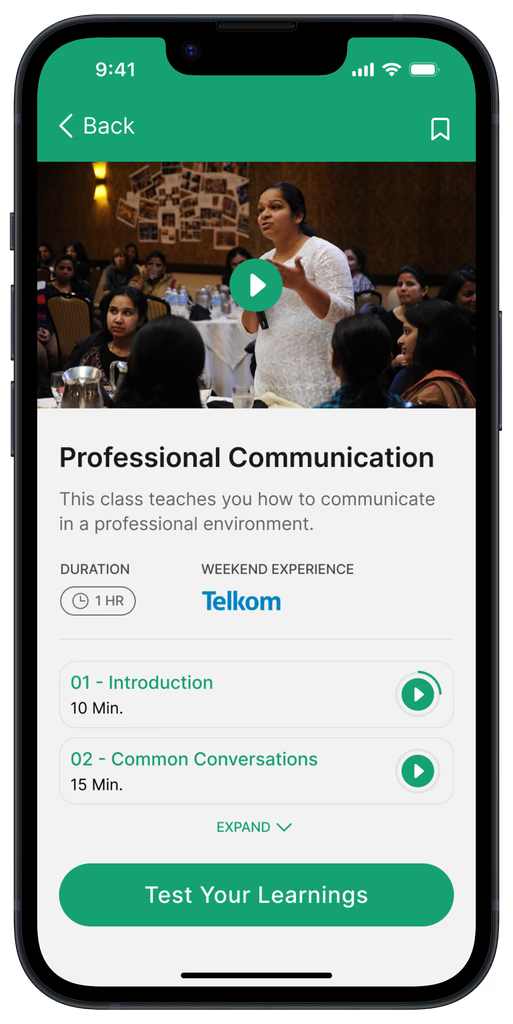
Users can sign up for weekend work experiences to try real jobs without leaving their current ones.
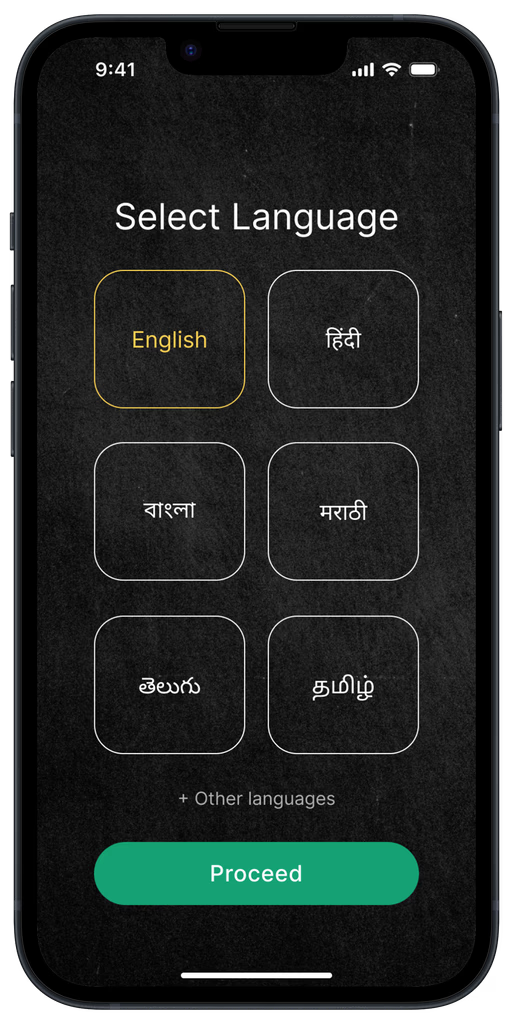
The app supports multiple Indian languages. This screen shows the home-screen interface in Hindi.
The visual & experiential consistency
I researched the existing services in the market to identify gaps and opportunities for the solution.
While there are skill development initiatives (e.g., Skill India), they often lack comprehensive post-training support, and only ~10% of Indians are comfortable with English as a primary language for learning, which most of these programs assume. Below are the key gaps identified:
Inflexible scheduling
Few part-time options that fit around existing work commitments.
Transition support missing
Minimal guidance during the critical phase between training and employment.
No end-to-end solutions
Rarely combine education, experience, certification, and placement in one flow.
High upfront costs
Most programs require significant financial investment with no guaranteed outcomes.
Language barriers
Limited offerings in regional languages restrict access for many workers.
I conducted in-depth interviews with 5 blue-collar workers and triangulated findings with secondary research to extract key insights and high-level user needs.
Below are the high-level findings that informed the design solution:
Limited time for upskilling due to demanding work schedules
3/5 participants reported working 10+ hour days with minimal days off, making traditional education models impossible to accommodate.
“I leave home at 6am and return at 8pm. Which training center is open at that time? And I can't afford to lose even one day's wages.”
— P3
Financial constraints prevent investment in education
Blue-collar workers cannot risk existing income for uncertain future benefits, creating a barrier to career advancement.
“They ask for ₹20,000 upfront for a 3-month course. That's more than my monthly salary!”
— P1
Language barriers limit access to quality training
Most educational content is available only in English, which creates an insurmountable barrier for regional language speakers.
“The videos are in English with technical terms I don't understand. I might understand better if they were explained in Hindi.”
— P2
Lack of guidance, mentorship, and awareness
Workers lack access to professionals who could provide career guidance and help navigate transition pathways. They are also unaware of roles to transition to due to a perceived gap in qualifications.
“I don't know anyone who works in an office. And I don't know what roles I can get into with my level of knowledge or what knowledge I need to get a good job.”
— P1
How might we help blue-collar workers grow their skills, get guidance, and find better jobs, in a way that respects their time, income, and language?
Two personas represented the distinct user needs within the blue-collar workforce.
Since personas can unintentionally introduce bias, these were deliberately crafted based on observed behaviors, goals, and barriers, not assumptions or demographics.

Ravi
“Career-seeking gig worker juggling uncertainty”
Current role
Delivery executive (gig-based work)
Goals
- Transition to a more stable, higher-paying role
- Learn skills without leaving current job
Barriers
- Long irregular work hours
- Limited access to affordable, language-friendly training
Needs
- Flexible, self-paced learning
- Career guidance from trusted sources
- Clear path from skill building to job placement

Sunita
“Overburdened caretaker seeking growth”
Current role
Domestic worker (multiple part-time jobs)
Goals
- Increase income through new skills
- Support family and secure consistent employment
Barriers
- Limited free time
- Low digital and English literacy
- Hesitancy to trust training programs
Needs
- Visual learning in a familiar language
- Affordable or low-risk training options
- Local or peer-based support to build trust
A brainstorming session was carried out to determine the features that would address the users' needs.
Here are the most important possible solutions, mapped against the problems to be solved:
Problem
Potential solutions
Language limitations: unable to understand content in English
- Collecting language preferences and tailoring app content to fit their needs
Lack of guidance, mentorship, awareness about roles & possibilities
- Community creation for mentor outreach
- In-app resume that updates on acquiring new skills
Lack of skills, unsure of what to learn, what's in demand
- Collecting data about their existing skillsets (preliminary assessment) to help filter their recommendations
- Modules teaching the most sought-after skillsets in industry related to their interests
- Skill bounties: weekly wanted-skills lists by hiring companies
Missing relevant experience and lack of self-trust to transition
- Weekend experience immersions with prerequisite skills
- Confidence building: daily fun quizzes
Time & income constraints, unable to leave existing jobs
- Bite-sized, focused learning modules only focusing on making them ready for hands-on training
- Basic-level professional communication courses recommended after an onboarding assessment, based on the results
From flows to a name to a validated task.
Wireframing & flows
Based on the ideation, I put together a user flow and a set of low-fi wireframes that captured the goals for each key section of the app. I separated the flows, and set aside goals for each one to make sure the wireframes actually addressed them.
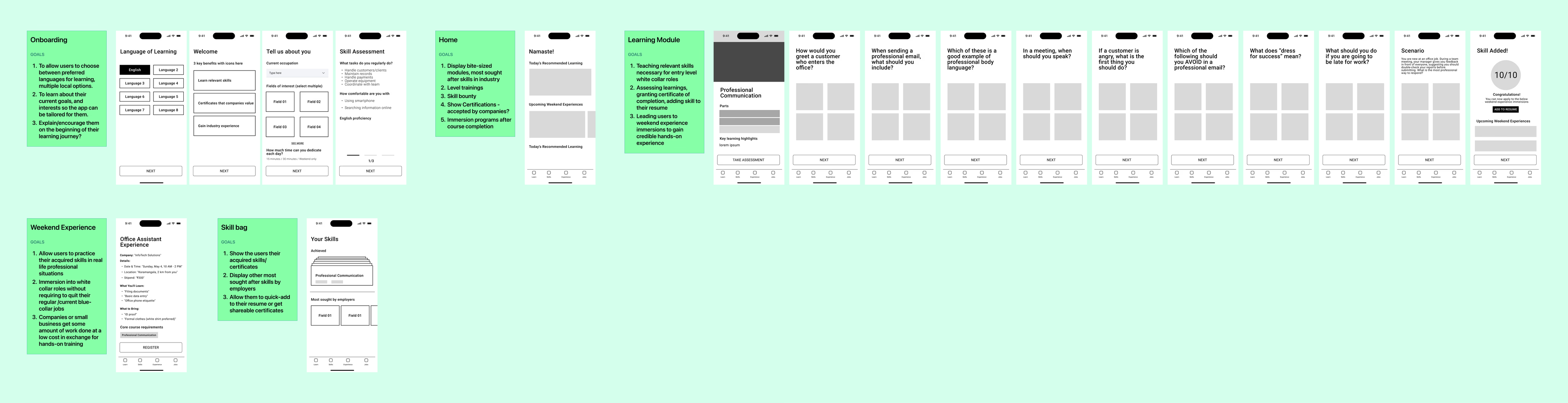
Drag around to view a glimpse of the wireframing of the key parts of the app.
Branding: the word 'Saksham' means capable.
To ground the visual language, I used a simple research prompt: “What makes you think of education, what are some of the most memorable things that you link to it?”
“I remember our school days with chalkboards and handwriting in ruled books.”
“…That black chalkboard, pencils, pens, dusters, even those chalk plates we had.”
“…School bell, chalkboard, and the long stick teacher used for teaching.”
Validating with users
Due to time constraints, I ran a quick usability test with 3 of the 5 interview participants on one key task: “You're interested in learning a new skill to improve your communication abilities. Show me how you'd begin a course for that, then what you'd do next to apply it in a real-world setting.” I chose a moderated think-aloud test focused on that one flow to get direct, real-time feedback on the most critical part of the experience.
Here's how it all came together!
Addressing the language barriers in learning
Language selection options offered at the onboarding for the users. These languages are decided based on the top spoken languages in India, in the order visible on the screen.
Designing for guided, low-effort exploration
The home screen helps users get started quickly, even if they're unsure what to learn. Based on research insights about limited time and lack of direction, it offers a recommended skill for the day, short 10-minute lessons, and a “Skills Companies Want” section to ensure relevance. Peer stories build confidence through relatable success paths, while suggested search terms reduce effort and decision fatigue.
Supporting quick, guided learning
The Learn flow addresses a key research insight: users hesitate to invest time in upskilling if it disrupts their main income. To reduce this barrier, Saksham offers 10-minute daily lessons that feel manageable. Each course also shows a related weekend experience it unlocks, making the value of learning clear and immediate.
Assessment flow, leading to certification
The assessment consists of 8 relevant questions to test users on what they've learned. Once they pass, the skill is added to their in-app resume as a certified achievement. The certification screen also introduces related weekend experiences unlocked by the skill, allowing users to register for hands-on opportunities to apply what they've learned in real-world settings.
Real-world immersion through weekend experiences
Research showed users lacked relevant experience for white-collar roles. Weekend experiences let them apply completed skills in real work settings, helping them gain practical exposure without leaving their current jobs.
Acknowledging limitations & what I would do differently.
As a short sprint project, I'm happy with the amount of work I was able to complete while maintaining a user-centered approach throughout the process.
One area I'd like to improve is thinking more deeply about happy paths and exit points. The current flows are quite optimistic and don't account for how users might approach tasks differently. As designers, we need to ensure we design meaningful exit points and not just focus on ideal scenarios.
This project also highlighted the importance of reaching more users during testing. A larger and more diverse participant pool in future rounds would provide more reliable and varied insights for iteration.
Next, I'd refine edge cases across flows, prototype the onboarding assessment to further personalize learning paths, and explore deeper integration with local employers to strengthen the link between skill-building and job placement.